
Meridian Review – Is This the New Way to Build Unique KDP Data Books?
If you are publishing low-content or print-on-demand books on Amazon KDP, you have probably noticed how difficult it has become to stand out.
Search almost any popular journal, planner, notebook, or generic low-content niche and you can find hundreds or even thousands of competing titles. Many look similar, target the same keywords, and offer very little differentiation.
That is where Meridian takes a different approach.
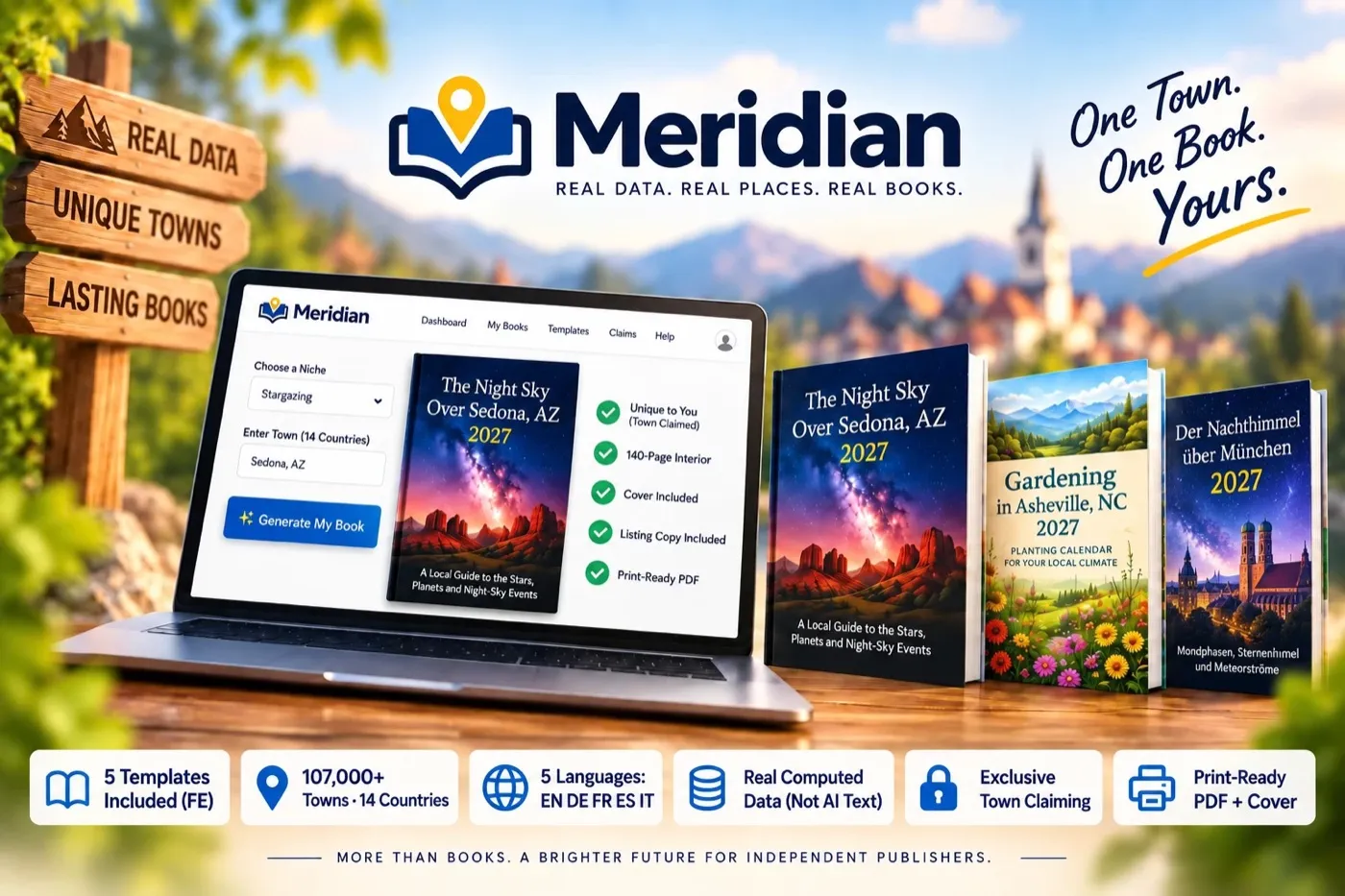
Instead of generating another generic AI-written book, Meridian creates location-specific data books based on a particular town. The software calculates information for the selected location and turns it into a print-ready KDP interior, matching cover, listing copy, and keywords.
The more interesting part is its town-claiming system: when you generate a particular town/template/year/language combination, Meridian locks that combination to your account so another Meridian user cannot generate the same edition.
In this Meridian review, we’ll look at exactly what the software does, how it works, its features, pricing, advantages, limitations, and whether it makes sense for KDP publishers.
Meridian is a web-based KDP data-book generation platform created by Thu Thao of Nova AI Platform.
The basic concept is simple:
Choose a town → choose a book template → generate → download → publish on KDP.
According to the official product information, Meridian can generate books using location-specific data such as:
- Sunrise and sunset information
- Moon phases
- Moonrise and moonset
- Planting information
- Weather statistics
- Prayer times
- Solunar fishing information
- Tide information
- Golden-hour photography information
- Hunting solunar information
- Moon gardening information
The software then packages the information into a formatted book rather than leaving you to manually research, calculate, design, and format everything yourself.
The official page describes the output as a 140-page, 6 × 9 print-ready interior, together with a matching full-wrap cover and listing information.
That makes Meridian fundamentally different from a typical AI content generator.
The process is designed to be relatively straightforward, even for someone who has never published this type of book before.
Step 1: Choose a Town
You enter the name of a town or location you want to target.
Meridian’s database covers more than 257,000 towns across 14 countries, according to the sales page.
You can potentially target:
- Your hometown
- Tourist destinations
- Small towns
- Fishing locations
- Gardening communities
- Photography destinations
- Local communities
- Towns with strong regional interest
The location is important because the generated data is calculated for that particular place.
Step 2: Select a Book Template
Meridian provides several front-end templates.
The included templates currently cover areas such as:
Night Sky
Create a location-specific astronomy book containing information about the night sky, moon phases, daylight patterns, and related information.
When to Plant
This template focuses on gardening and planting information based on local conditions.
The Weather Year
A location-specific weather data book containing climate information such as normal highs, lows, rainfall, and related statistics.
Prayer Times
Create annual prayer-time books based on the selected location and prayer-time calculation conventions.
Solunar Fishing Calendar
This template targets anglers with fishing-related solunar information and fishing logs.
Additional templates are available through the product’s Template Vault, including options aimed at tides, photography, hunting, and moon gardening.
Step 3: Generate Your Book
Once you select the town and template, Meridian does the computational and formatting work.
The official sales page says generation takes approximately two minutes.
Instead of manually:
- Collecting data
- Calculating dates
- Formatting hundreds of entries
- Designing an interior
- Creating a cover
- Writing listing information
- Researching keywords
Meridian produces the main publishing assets in a single workflow.
One of the strongest aspects of Meridian is that it is not simply giving you raw data.
The product is designed to provide a publishing-ready package.
According to the sales page, generated output can include:
1. Print-Ready Interior
The generated book is formatted as a 6 × 9 interior with approximately 140 pages.
2. Full-Wrap Cover
A matching cover is generated for the book and personalized according to the selected location and edition.
3. Listing Copy
Meridian also provides:
- Title
- Subtitle
- Description
- 7 backend keywords
This can reduce the amount of time needed to prepare a KDP listing.
4. Claim Certificate
The system provides a certificate associated with the town/edition you claim.
5. Multiple Interior Styles
The platform includes different interior themes so publishers aren’t restricted to one visual format.
6. Dedication Pages
The books can also include dedication/gift-oriented elements, which could be useful for certain keepsake-style products.
This is arguably the feature that makes Meridian stand out.
Most KDP software lets you generate a book.
Meridian attempts to add another layer:
Location-based exclusivity among Meridian users.
When you generate a qualifying town/template/year/language combination, the system claims it for your account.
The official sales page says that other Meridian users will see the location marked as TAKEN and will not be able to generate that same combination.
That doesn’t mean you own the town, the underlying geographic data, or an exclusive Amazon market.
It means Meridian’s own user system prevents another Meridian user from generating the same claimed combination.
That’s an important distinction.
Still, it creates an interesting strategy for KDP publishers because you aren’t simply generating another generic book that hundreds of other users can produce with the same software.
One Town Can Create Multiple Publishing Opportunities
Another interesting concept is that one location isn’t necessarily limited to one book.
For example, suppose you choose a particular town.
You could potentially create different editions such as:
- Night Sky book
- Weather book
- Planting calendar
- Prayer-time book
- Fishing calendar
Each serves a different audience.
The sales page also explains that claims are associated with combinations such as template, town, year, and language.
That means the same geographical location can potentially be used across different product concepts rather than producing only one title.
Multiple Languages
Meridian also supports multiple languages.
The sales page currently lists:
- English
- German
- French
- Spanish
- Italian
It also supports locations across countries including:
- United States
- Canada
- United Kingdom
- Ireland
- Australia
- New Zealand
- Germany
- Austria
- Switzerland
- France
- Belgium
- Spain
- Italy
- Mexico
This opens the possibility of creating localized editions rather than publishing everything exclusively in English.
For example, a publisher could target a German-speaking audience with a localized edition instead of simply translating an English title.
Historical Editions Are Another Interesting Feature
Meridian also supports historical editions going back to 1940 for applicable templates.
This could create some interesting keepsake-style products.
For example:
“The Night Sky Over [Town] – 1990″
or
“The Weather Year in [Town] – 1985″
The concept could potentially appeal to people interested in:
- Birth years
- Anniversaries
- Historical keepsakes
- Family memories
- Local history
- Gifts
The software also accounts for historical daylight-saving rules where applicable.
This is a more specialized approach than simply creating another generic notebook.
Meridian Is NOT a Typical AI Book Generator
This deserves attention.
There are countless AI tools that promise to generate books by producing:
- Articles
- Stories
- Blog posts
- Fiction
- Journals
- Prompts
- Planners
Meridian takes another route.
Its primary output consists of computed data tables rather than AI-generated prose.
For example, astronomical information can be calculated for a specific location, while weather and frost-related information can be based on relevant public datasets.
This makes the product closer to a data-book publishing engine than an AI copywriting tool.
That distinction is important if you’re looking for something different from the increasingly crowded AI-content market.
Here’s a quick overview of the major features.
| Feature | Meridian |
|---|---|
| Web-based software | Yes |
| KDP-focused | Yes |
| Location-specific books | Yes |
| 257,000+ towns | Yes |
| Multiple countries | Yes |
| Multiple languages | Yes |
| Print-ready interiors | Yes |
| Full-wrap covers | Yes |
| Listing copy | Yes |
| Backend keywords | Yes |
| Town claiming | Yes |
| Historical editions | Yes |
| Multiple book templates | Yes |
| Subscription required | No for front-end |
| KDP publishing experience required | No |
| AI-generated book text | No |
| Computer installation | No |
The launch offer shown on the sales page lists the front-end price at:
$17 One Time
The sales page states that this is a one-time payment, rather than a recurring monthly subscription.
The front-end package includes the main Meridian functionality and a set of town claims.
The sales page currently lists 25 exclusive town claims with the front-end offer.
There are also optional upgrades available after purchase.
Important:
Do not purchase Meridian simply because it is inexpensive.
The software can generate the book assets, but it does not guarantee sales, rankings, or income.
Your results will still depend on factors such as:
- Your chosen locations
- Keyword research
- Book positioning
- Cover appeal
- Pricing
- Amazon search visibility
- Competition
- Reviews
- Marketing
- Publishing consistency
1. It Attacks the “Clone” Problem
Generic KDP books can be extremely competitive.
A location-specific data book provides a different angle.
Instead of:
“Daily Planner 2026”
you’re creating something closer to:
“The Night Sky Over [Specific Town] – 2027″
That’s a much more specialized product concept.
2. The Location-Based Concept Is Interesting
The local angle gives publishers many possible niches.
A small town that isn’t attractive enough for a large publishing company could still potentially have residents, visitors, hobbyists, or gift buyers interested in local information.
3. It Saves Research and Formatting Time
Manually creating 365 days of location-specific data would be tedious.
Meridian automates much of that process.
The ability to receive the interior, cover, and listing materials together can simplify the workflow.
4. No Monthly Subscription on the Front End
The listed $17 front-end offer is a one-time payment.
For publishers who dislike accumulating monthly software subscriptions, that is worth considering.
5. Multiple Niches From One Platform
You’re not locked into a single subject.
Depending on the template available to your account, you can explore:
- Astronomy
- Gardening
- Weather
- Prayer
- Fishing
- Tides
- Photography
- Hunting
- Moon gardening
That gives the software broader potential than a single-purpose KDP generator.
6. Multiple Languages
The ability to produce localized editions in several languages could give publishers additional markets to research.
A professional review should also look at the limitations.
1. Meridian Does Not Guarantee Sales
This is the biggest point to understand.
Meridian can help you create the product.
It cannot guarantee that Amazon customers will buy it.
You still need to do the marketing and publishing work.
2. You Still Need a KDP Account
Meridian isn’t Amazon KDP.
You still need to:
- Create your KDP account
- Upload your files
- Complete your listing
- Set pricing
- Follow Amazon’s publishing requirements
- Check your book
- Handle publishing decisions
The tool reduces the production work, but it doesn’t remove the publishing process.
3. Town Exclusivity Has Limits
The word “exclusive” needs to be understood correctly.
Meridian can prevent other Meridian users from generating the same claimed combination.
That doesn’t mean another publisher outside Meridian can’t publish information about the same town.
This distinction is important before purchasing.
4. Some Templates Have Geographic Restrictions
Not every template works everywhere.
The official information indicates that certain templates relying on NOAA data are restricted to U.S. locations and English.
Therefore, you should check the supported locations and templates before planning a large publishing strategy.
5. All Sales Are Final
The official sales page states that Meridian does not offer refunds.
That’s particularly important because the front-end price may be low, but you should still understand what you’re buying before purchasing.
I think Meridian makes the most sense for people who fall into one of these categories:
KDP Beginners
If you want to create specialized data books without spending hours doing calculations and formatting, Meridian can simplify the initial production process.
Existing KDP Publishers
Existing publishers may find the location-based concept useful for expanding their catalogs.
Niche Publishers
If you enjoy researching small geographic niches, local communities, hobbies, gardening, fishing, astronomy, or similar subjects, Meridian offers several directions to explore.
Gift Book Publishers
Historical editions and location-specific books could potentially be positioned as keepsake or gift products.
Catalog Builders
The model is particularly interesting for publishers who prefer building a larger catalog instead of relying on one book.
Meridian may not be appropriate if you:
- Don’t want to publish on Amazon KDP
- Expect instant passive income
- Don’t want to research niches
- Don’t want to upload and manage books
- Expect the software to do the marketing
- Want a traditional AI article-writing tool
- Expect guaranteed sales
The sales page itself makes an important point: Meridian is a tool, not a paycheck.
That’s probably the right way to approach it.
Pros
- Location-specific KDP books
- Interesting differentiation from generic low-content books
- 257,000+ listed towns
- Multiple countries
- Multiple languages
- Multiple book categories
- Print-ready interior
- Matching cover
- Listing copy included
- Backend keywords included
- Town claiming system
- Historical editions
- Web-based
- No software installation
- One-time front-end price
Cons
- No guaranteed sales
- KDP publishing is still required
- Exclusivity is limited to the Meridian ecosystem
- Some templates have geographic restrictions
- Additional upgrades are available
- All sales are final
- Success still requires keyword and niche research
- Amazon policies still apply
The answer depends heavily on what you’re trying to accomplish.
If you’re searching for another tool that simply spits out AI-written books, Meridian isn’t really that product.
Its approach is different.
The interesting proposition is the combination of:
local data + specialized book formats + automated production + town claiming.
That gives KDP publishers a way to move away from extremely generic products and experiment with more specialized, location-based books.
However, I would not look at Meridian as a magic “make money on KDP” button.
The software can reduce the production barrier.
It cannot replace:
- Market research
- Keyword research
- Product positioning
- Quality control
- KDP compliance
- Publishing
- Marketing
If you’re prepared to do those things, Meridian becomes much more interesting.
Meridian is an unusual KDP publishing tool because its primary selling point isn’t AI-generated writing.
It’s specificity.
Instead of trying to create another generic book for a massive keyword, the idea is to create a specialized product around a particular location and data set.
The town-claiming mechanism adds another interesting layer because Meridian users cannot simply generate the same claimed combination through the platform.
I particularly like the concept of combining different templates with different towns, years, languages, and audiences.
But I would keep expectations realistic.
Meridian doesn’t guarantee that a book will sell.
Think of it as a production tool that can help you create differentiated KDP products faster—not as an automatic income machine.
If you already have an interest in KDP publishing and want to experiment with location-based data books, Meridian is certainly worth investigating.
Want to Check Meridian?
You can check the current offer and see whether your target town is available here:
👉 Check Meridian & Current Offer
Before purchasing, I recommend checking whether your preferred town is still available and reviewing the included templates and limitations.
What is Meridian?
Meridian is a web-based tool designed to create location-specific data books for Amazon KDP.
Does Meridian write books using AI?
Not in the traditional AI-writing sense. Its main output consists of computed data and formatted tables rather than AI-generated articles or stories.
How much does Meridian cost?
The launch offer shown on the sales page lists the front-end at $17 one time. Pricing may change after the launch period.
How many towns are available?
The sales page states that Meridian covers more than 257,000 towns across 14 countries.
Can I publish books in other languages?
Yes. The currently listed languages include English, German, French, Spanish, and Italian.
Can I create historical editions?
Yes. Applicable templates can generate editions going back to 1940.
Does Meridian guarantee KDP sales?
No. There is no guarantee of sales, rankings, or income.
Does Meridian include book covers?
Yes. A matching full-wrap KDP cover is included with generated books.
Does Meridian include listing information?
Yes. The generated package includes title, subtitle, description, and seven backend keywords.
Is Meridian a monthly subscription?
The front-end offer is presented as a one-time purchase. Optional upgrades may be offered separately.
Do I need design software?
No. Meridian is a web application and generates the main interior and cover assets for you.
Can beginners use Meridian?
The workflow is designed to be beginner-friendly, but you still need to understand Amazon KDP’s publishing requirements.
Is Meridian affiliated with Amazon?
No. Meridian states that it is not affiliated with Amazon KDP.
Rather than judging Meridian solely by the promise of making money, I would evaluate it based on what it actually provides:
Concept: Location-specific KDP data books
Automation: High for book production
Ease of use: Beginner-friendly
Differentiation: Strong concept
KDP usefulness: Potentially valuable for niche publishers
Income guarantee: None
Best use: Building a differentiated KDP catalog
If you understand that distinction, Meridian becomes much easier to evaluate.
Ready to explore Meridian?
👉 Check the Meridian offer and availability here:
Disclosure: This article contains an affiliate link. If you purchase Meridian through our link, MegaReviewz may receive a commission at no additional cost to you. Our review is intended to provide information to help you make your own purchasing decision.