Creating digital products from scratch can take a huge amount of time.
You need to research a topic, organize the information, write the content, create supporting materials, prepare promotional copy, and then package everything into something customers can actually use.
But what if you already have useful content sitting on your computer?
Maybe you have PLR reports, articles, ebooks, guides, checklists, or other properly licensed content that could be turned into something much more valuable.
That’s where (PLR) AI Content Repurposer (Master Prompt Pack) comes in.
In this AI Content Repurposer PLR Review, I’ll explain what the product does, how the workflow works, what the PLR license allows, who it may be suitable for, its potential limitations, and what you should know before buying.
Affiliate Disclosure: This review contains an affiliate link. If you purchase through my link, I may receive a commission at no additional cost to you.
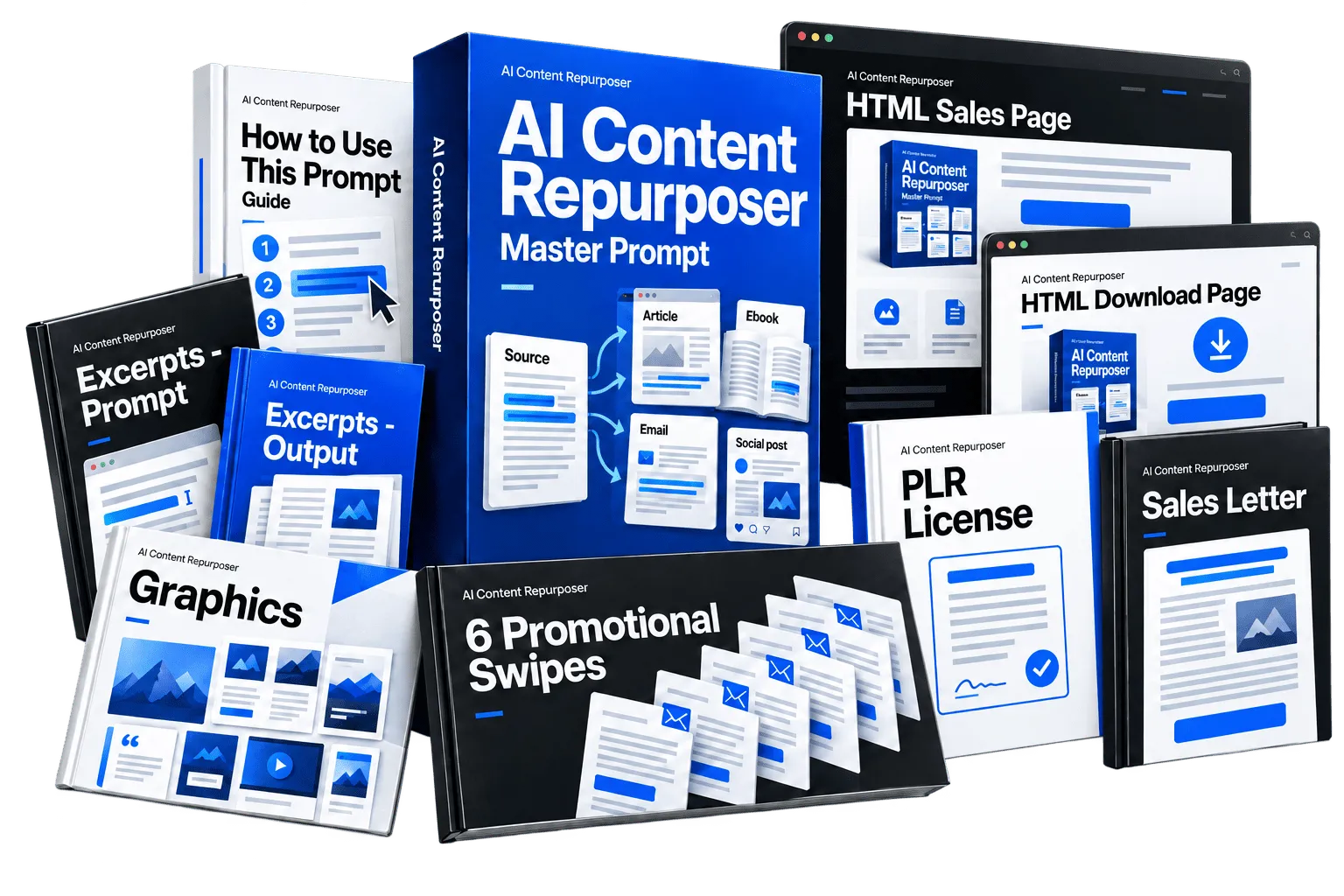
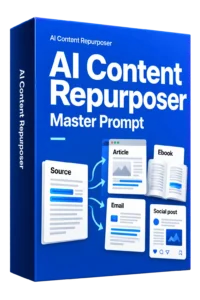
AI Content Repurposer (Master Prompt Pack) is a PLR product built around a structured master prompt designed to help users transform existing content into new digital assets.
Instead of creating every asset separately, the workflow is designed to take your source material and guide AI through a sequence involving planning, content creation, checking, revisions, and delivery.
According to the sales material, the system can be used with content such as reports, articles, ebooks, guides, and properly licensed PLR material.
The concept is simple:
One piece of content → multiple useful content assets.
For example, a single report could potentially be transformed into:
- An ebook
- A checklist
- A blog post
- Email messages
- Promotional copy
- A PLR license document
- Other supporting content
The exact output depends on what you ask the workflow to create and the capabilities of the AI tools you’re using.
One of the more interesting aspects of this product is its structured intake process.
Rather than immediately asking AI to rewrite something, the master prompt first gathers information about the project.
The sales-page workflow uses six main questions.
1. What Is Your Source Material?
You provide the content you want to work with.
This could be text or an uploaded file, depending on the AI platform and file formats available to you.
2. Do You Have Permission to Use the Content?
This is an important step.
The workflow asks whether you own the material or have appropriate rights to modify it.
That’s particularly relevant for PLR users because not every piece of content found online can legally be repurposed.
If you don’t have appropriate rights, you shouldn’t use the workflow to transform that material.
3. What Do You Want to Create?
Next, you specify the desired output.
You can request a single asset or a collection of related assets.
For example:
Source report → Ebook + checklist + blog post + emails + promotional copy
This approach can potentially save considerable time compared with creating each item individually.
4. What Tone Should Be Used?
You can provide instructions regarding the desired tone and style.
For example:
- Professional
- Conversational
- Educational
- Friendly
- Persuasive
- Beginner-friendly
This gives the AI more context before it starts generating the content.
5. How Much Should the Content Be Changed?
The workflow also allows you to specify the depth of transformation.
You may want a relatively straightforward rewrite, or you may want the material substantially reorganized and expanded.
You can also include additional instructions, such as asking the AI to check the work before final delivery.
6. Do You Want to Review the Plan First?
Another useful option is the ability to have the workflow prepare a plan before producing the final content.
For larger projects, this can be valuable because you can review the proposed structure before spending time generating the complete package.
The biggest attraction is the ability to turn one source into a collection of connected assets.
Imagine you have a 30-page report.
Instead of leaving it as a single PDF, you could potentially develop a content package around it.
For example:
Original Report
↓
New Ebook
↓
Checklist
↓
Blog Article
↓
Email Sequence
↓
Sales Copy
↓
Promotional Content
This is particularly interesting for digital marketers and PLR sellers because one properly licensed source can become the foundation for a broader product ecosystem.
The sales material also mentions potential applications involving courses, presentations, spreadsheets, and webpages, although the exact capabilities depend on the AI tools and file handling available to the user.
A Real Demonstration Is Included
One thing I found useful when researching this product is that the sales page doesn’t rely entirely on theoretical claims.
It presents a step-by-step example showing how the workflow can be used.
The sales material also provides access to several sample PDF files, including examples associated with the demonstrated project.
The independent SMMOWL review notes that the sales page provides seven linked example files, allowing potential buyers to inspect the types of outputs being demonstrated before purchasing.
That’s helpful because AI products can sound impressive in a sales letter, but seeing examples gives you more information about the intended workflow.
However, it’s important to distinguish between seeing vendor-provided examples and independently testing every output yourself.
PLR Rights – An Important Advantage
If you’re buying this specifically because you want to create and sell digital products, the licensing terms deserve close attention.
According to the sales-page information reviewed by SMMOWL, the product allows buyers to pass PLR rights to their own customers, subject to the stated restrictions.
The documented permissions include the ability to:
- Edit the content
- Rewrite the content
- Make it shorter or longer
- Add your own branding
- Sell the resulting products
- Bundle the content with paid offers
- Use associated sales materials for marketing
- Pass PLR rights to customers under the license terms
There are also restrictions.
For example, the license information indicates that buyers cannot simply give away the source files, claim exclusive ownership of the material, or distribute the files through free-download/torrent/giveaway channels.
Always read the actual license included with your purchase before reselling or redistributing anything.
That’s especially important with PLR products because licensing conditions can determine exactly how you are allowed to package and sell the material.
1. Structured Workflow
This isn’t presented as a random collection of hundreds of unrelated prompts.
The master prompt follows a logical process:
Source → Rights → Goal → Tone → Depth → Approval → Production
That structure can make large AI projects easier to manage.
2. Multiple Outputs From One Source
The repurposing concept is practical.
If you already have useful content, you may be able to create several supporting assets without starting each project from zero.
3. Useful for PLR Marketers
The product is particularly relevant to people who already work with PLR.
Instead of selling one generic report, a marketer could potentially build a more complete product package around properly licensed source material.
4. Clearer License Information
The publicly described licensing terms are relatively detailed compared with many PLR offers.
Knowing what you can and cannot do before purchasing is important.
5. Example Outputs
The availability of example files gives potential buyers something concrete to examine rather than relying exclusively on marketing claims.
6. Beginner-Friendly Concept
You don’t necessarily need advanced prompt-engineering knowledge to understand the basic workflow.
The idea is essentially:
Give the AI the source → answer the setup questions → specify what you want → let the workflow guide the project.
No product is perfect, and there are several things you should consider before buying.
AI Output Still Needs Review
AI can produce incorrect information, repetitive writing, awkward phrasing, or content that doesn’t fully match your intended audience.
You should review and edit important content before publishing or selling it.
Think of the system as a content production assistant, not a replacement for human quality control.
Your Source Material Matters
The quality of the final product will depend partly on the quality of your original material.
If the source content is outdated, poorly written, inaccurate, or poorly structured, AI cannot automatically turn it into a perfect product.
ChatGPT Is Required
The product is designed around using ChatGPT or compatible AI capabilities.
You therefore need access to an AI environment capable of handling the type and size of project you’re attempting.
The sales information doesn’t prescribe one particular ChatGPT subscription tier, so users working with very large files or extensive projects should check the current capabilities and limits of their account.
It Doesn’t Build Your Business Strategy
A master prompt can help with production.
It doesn’t automatically provide:
- A profitable niche
- A validated product idea
- A customer list
- Traffic
- Buyers
- Affiliate sales
- Guaranteed revenue
You still need to decide what to create, who you’re creating it for, how you’ll position it, and how you’ll market it.
I think the concept is most relevant to:
PLR Sellers
If you regularly purchase PLR material, the workflow can help you think beyond simply selling the original PDF.
You can potentially create additional assets around the same source material.
Affiliate Marketers
Affiliate marketers can use content repurposing to develop supporting blog posts, emails, lead magnets, and promotional materials around their campaigns.
Content Creators
If you have a large library of existing articles, guides, or reports, repurposing can help you extract more value from that content.
Digital Product Creators
People creating ebooks, checklists, reports, courses, and other digital products may find the structured workflow useful.
Agencies and Freelancers
A structured repurposing workflow could also be useful for producing different content assets for clients, provided the underlying content and usage rights are appropriate.
This may not be particularly useful if:
- You rarely create digital content.
- You don’t have source material to repurpose.
- You expect completely finished content without editing.
- You’re looking for an autonomous business that generates sales for you.
- You don’t want to work with AI tools.
- You don’t understand or intend to follow PLR licensing requirements.
The product is being offered through a dime-sale pricing structure.
The SMMOWL review reported a starting price of $5.95, with the price increasing as sales are made, and recorded approximately $6.48 at the time of its review. The maximum listed price was reported as $27.
Because dime-sale pricing can change, check the current checkout price before purchasing.
There may also be additional offers in the funnel, so don’t assume that purchasing the front-end product requires purchasing every upgrade.
The answer depends heavily on what you plan to do with it.
If you’re simply looking for another collection of generic AI prompts, this may not be what you’re expecting.
The more interesting use case is the workflow.
If you already have reports, articles, ebooks, guides, or properly licensed PLR content, the ability to systematically turn one source into several connected assets could save you considerable time.
The explicit resale/PLR permissions also make the offer more relevant to people who create and sell digital products.
However, don’t buy it expecting the prompt itself to generate guaranteed income.
You’ll still need to provide quality source material, review the AI output, make appropriate edits, follow the license, and handle your own marketing.
(PLR) AI Content Repurposer (Master Prompt Pack) takes an interesting approach to AI-assisted content creation.
Rather than focusing on generating one article or one ebook, it focuses on creating a structured workflow for transforming existing content into a collection of related assets.
The six-question setup is one of its more interesting features because it establishes the source material, rights, desired outputs, tone, transformation level, and approval process before the main work begins.
For PLR marketers, digital product creators, affiliate marketers, and content creators who already have a library of material, this could be a useful addition to their workflow.
Just keep your expectations realistic.
It can help with content production, but it isn’t a magic business-in-a-box.
If you’re interested in seeing the current offer, pricing, and licensing details, you can check it out here:
👉 Get AI Content Repurposer + PLR Rights
Check Current Price & Get Access
Prices, availability, bonuses, and offer terms can change. Review the current checkout page and license terms before purchasing.
What is AI Content Repurposer?
AI Content Repurposer is a master-prompt workflow designed to help transform existing content into multiple digital assets using AI.
Do I need existing content?
Yes. The concept is primarily designed around repurposing existing source material such as reports, articles, ebooks, guides, or properly licensed PLR content.
Can I sell the content I create?
The publicly described license allows buyers to sell the resulting products and pass PLR rights to customers, subject to the stated license restrictions. Always check the actual license supplied with your purchase.
Can I use PLR content with it?
Yes, provided you have appropriate rights to modify and repurpose the source material.
Does it guarantee sales?
No. The product is a content-production workflow. Your results will depend on factors such as your niche, source material, product quality, positioning, audience, traffic, and marketing.
Does it replace human editing?
No. AI-generated content should be reviewed, fact-checked, edited, and customized before publication or resale.
Is this an AI software platform?
The core offer is centered around a master prompt/workflow used with AI rather than being presented as a standalone SaaS platform.
Is there an upsell funnel?
There may be additional offers presented during checkout. These are separate from the core front-end purchase, so review each offer independently before buying.